How to Choose Right Baby Toys in Bangladesh: A Parent's Complete Guide
Oct 13, 2026
If you are wondering how to choose right baby toys in Bangladesh, the short answer is this: pick toys that match your baby's exact age stage, are made from non-toxic and washable materials, have no small detachable parts, and invite your child to touch, move, think and talk instead of just watch. Price, brand name and flashy lights matter far less than safety and developmental fit.
Walk into any toy shop in Dhaka, Chattogram or Sylhet, or scroll through Facebook pages and online marketplaces, and you will find thousands of options. Plastic rattles, musical phones, battery-powered cars, wooden puzzles, soft books, imported "educational" tablets. Many look similar in photos, yet they differ hugely in quality, safety and real value for your child.
This guide is written for Bangladeshi parents, grandparents and gift-givers who want to buy smarter. You will learn what toys suit each age from newborn to 3 years, a practical safety checklist you can use in any shop, which materials work best in our humid climate, how to spot fake or unsafe products, and how to get more learning out of every taka you spend.
Why Does Choosing the Right Baby Toy Matter So Much?
The right toy matters because the first three years are when a child's brain grows faster than at any other time in life, and play is the main way babies learn. A well-chosen toy gives your baby repeated chances to practise grasping, focusing, problem-solving and early language. A poorly chosen one either bores them, frustrates them, or in the worst case, puts them at risk.
Think of toys as tools rather than entertainment. A simple stacking ring teaches size order, hand-eye coordination and cause and effect. A cloth book builds vocabulary when you name the pictures together. A crawling tunnel strengthens the muscles your baby needs for walking. None of these need batteries.
What experts say about simple toys
The American Academy of Pediatrics, in its guidance on choosing toys for young children, encourages parents to favour simple, traditional toys over electronic ones. The reason is practical. When a toy does all the work with lights, songs and voices, the child becomes a spectator. When a toy is open-ended, the child has to act, imagine and communicate, and that is where learning happens.
The guidance also stresses that the best "toy" of all is a parent or caregiver who plays alongside the child. A wooden block becomes a far richer learning tool when Ammu or Abbu sits on the floor and says, "Look, you put the red one on top!"
Why this is especially important for Bangladeshi families
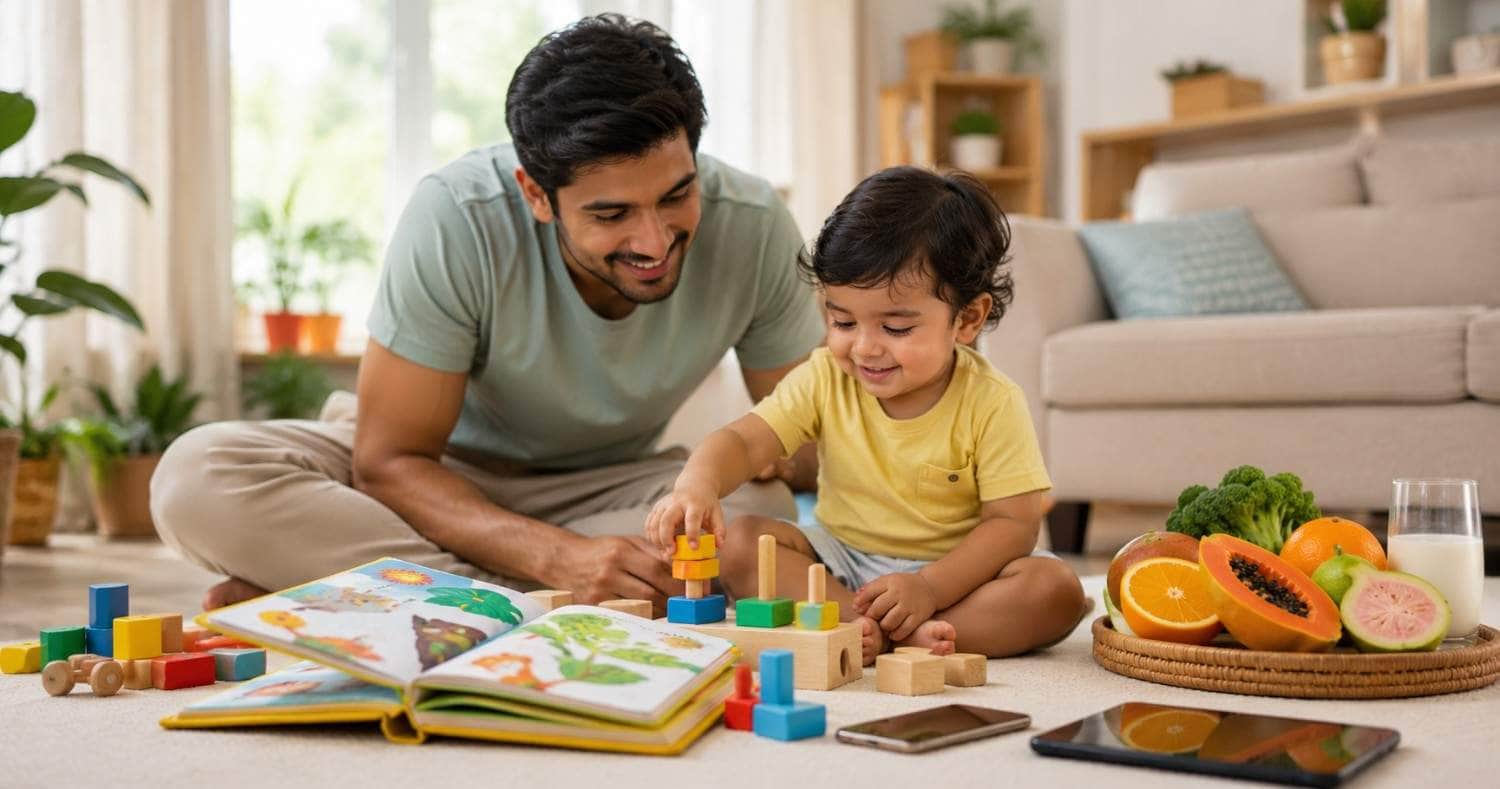
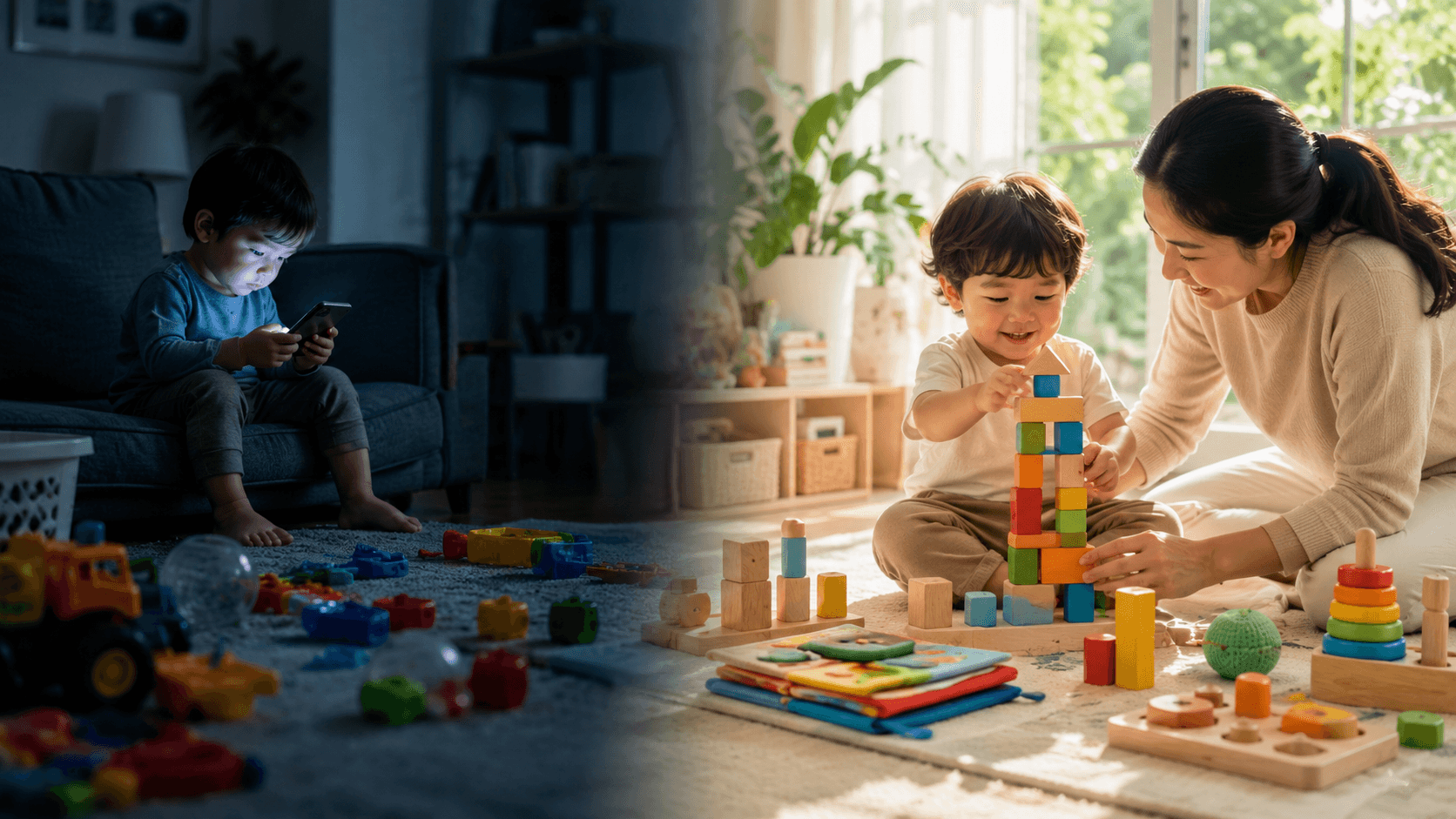
Many families in Bangladesh live in apartments with limited floor space, and screen time has crept into early childhood faster than most parents expected. Toys that are compact, durable and genuinely engaging help reduce dependence on mobile phones and YouTube for keeping a baby busy. They also give grandparents and helpers at home an easy, structured way to play with the child.
What Are the Best Baby Toys for Each Age?
The best baby toy is one that matches what your child is learning to do right now, not what the box says or what an older cousin enjoyed. Babies change quickly, so a toy that is perfect at 4 months may be useless at 10 months. Use the table below as a quick reference, then read the details for each stage.
Age
What your baby is learning
Best toy types
Avoid
0 to 3 months
Focusing eyes, tracking sound, recognising faces
High-contrast black and white cards, soft rattles, cloth mobiles, mirror toys
Anything with small parts, heavy toys near the face
4 to 6 months
Reaching, grasping, mouthing, rolling
Silicone teethers, wooden rattles, soft balls, textured cloth toys
Toys with paint that chips, long strings or ribbons
7 to 9 months
Sitting, crawling, cause and effect
Stacking rings, nesting cups, crawling tunnels, push-and-pop toys
Toys small enough to swallow, sharp plastic edges
10 to 12 months
Pulling up, standing, first words
Push walkers, shape sorters, board books, busy boards
Ride-on toys without stable bases
13 to 24 months
Walking, problem-solving, pretend play begins
Simple puzzles, building blocks, busy cubes, pull-along toys, toy kitchen sets
Toys with magnets or button batteries
2 to 3 years
Language burst, imagination, fine motor skills
Bead threading, egg-and-cup matching, construction sets, colouring, role-play toys
Overly complex kits that cause frustration
0 to 3 months: the looking and listening stage
Newborns cannot grab much yet, but they are absorbing everything they see and hear. Their eyesight is blurry, so bold black and white patterns hold their attention far better than pastel colours. Choose a few high-contrast cards, a soft rattle you can shake beside them, and a baby-safe mirror for tummy time. You do not need many toys at this stage. Your face and voice are the most powerful stimulation.
4 to 6 months: the grab-and-mouth stage
Now your baby reaches, grabs and puts everything into their mouth. This is normal and important, because the mouth is a key sensing organ. That makes material safety critical. Food-grade silicone teethers and untreated or water-based-finished wooden rattles are excellent choices. Teething usually begins around this period, so a teether that is easy to wash and chill will save many sleepless nights.
7 to 9 months: the sit, crawl and discover stage
Once babies sit steadily, their hands are free to explore. Stacking rings, nesting cups and simple drop-in boxes teach cause and effect: "I drop it, it falls, it makes a sound." When crawling begins, a crawling tunnel or soft play mat gives a safe space to build strength. In small Dhaka flats, a foldable tunnel is a practical way to encourage movement without needing a big room.
10 to 12 months: the stand and say stage
Around the first birthday, many babies pull up to stand and say their first words. Push walkers with a wide, stable base support those first steps. Shape sorters and busy boards with latches, switches and knobs keep curious hands busy. Sturdy board books are ideal now, especially ones with familiar objects like fruits, animals and vehicles you can name in Bangla and English.
13 to 24 months: the busy toddler stage
Toddlers want to do everything themselves. Simple wooden puzzles with knobs, building blocks, busy cubes and pull-along toys match this drive for independence. Pretend play also starts, so a small kitchen set or doll lets your child copy what they see at home. Choose toys that can be used in many ways, because toddlers lose interest in single-function toys quickly.
2 to 3 years: the talk and imagine stage
This is the age of the vocabulary explosion and endless "why?" questions. Bead threading, colour sorting, egg-and-cup matching games and simple construction sets build fine motor control needed later for holding a pencil. Role-play toys like doctor kits, shop sets and animal figures develop language and social skills. Keep challenges slightly above your child's current level, not far above it.
How Can You Tell If a Baby Toy Is Safe?
A baby toy is safe when it has no parts small enough to choke on, no toxic paint or chemical smell, no sharp edges, no loose strings or batteries, and is sturdy enough to survive being thrown, chewed and stepped on. Many low-cost imported toys sold in local markets and online in Bangladesh skip proper testing, so it is worth checking yourself before you buy.
The 8-point safety checklist
Use this checklist in a shop or when a delivery arrives:
Do the toilet roll test. If a toy or any part of it fits through an empty toilet paper roll, it is a choking hazard for children under 3.
Smell it. A strong chemical or plastic smell can signal cheap materials or solvent-based paints. Good-quality wood, cotton and silicone have little or no smell.
Scratch the paint gently. If paint flakes with a fingernail, your baby will chew it off too. Look for water-based, non-toxic finishes.
Pull every part. Eyes on soft toys, wheels on cars and beads on strings should not come loose with a firm tug.
Run your fingers along every edge. Wood should be sanded smooth, with no splinters. Plastic should have no sharp seams.
Check strings and cords. Any cord longer than about 30 cm is a strangulation risk for babies.
Look at batteries and magnets. Button batteries and small magnets are extremely dangerous if swallowed. Battery compartments must be screwed shut.
Ask about safety standards. Reputable sellers can tell you whether a toy meets recognised international standards such as EN-71 (Europe) or ASTM F963 (USA).
Red flags when buying online
Online shopping is convenient, but it is also where most unsafe toys reach Bangladeshi homes. Be cautious when you see:
Product photos copied from foreign websites with no real photos of the actual item
No mention of material, age range or safety information
Prices that are dramatically lower than every other seller
No physical address, phone number or return policy
Reviews that all sound the same or were posted on the same day
When in doubt, message the seller and ask for a real video of the product, its material and its recommended age. A trustworthy shop will answer clearly.
Which Toy Material Is Best for Babies in Bangladesh?
For most babies in Bangladesh, natural wood with a non-toxic finish and food-grade silicone are the best materials, with organic cotton fabric close behind. They are safer to mouth, last longer and are easier to keep clean than cheap hard plastic. The right choice also depends on our hot, humid climate, which affects how toys age.
Material
Safety for mouthing
Durability
Cleaning
Works well in humid weather?
Best for
Natural wood (water-based finish)
High
Very high, lasts years
Wipe with damp cloth, dry fully
Yes, if dried properly and stored off the floor
Rattles, blocks, puzzles, stacking toys
Food-grade silicone
Very high
High
Wash with soap or boil
Yes, does not absorb moisture
Teethers, bath toys, stacking rings
Organic or soft cotton fabric
High
Medium
Machine or hand wash
Needs sun drying, can hold dampness
Soft toys, cloth books, sensory balls
BPA-free quality plastic
Medium to high
Medium
Easy to wash
Yes
Shape sorters, push toys
Cheap unbranded plastic
Low, may contain harmful chemicals
Low, cracks easily
Easy but cracks trap dirt
Fades and becomes brittle in heat
Best avoided for babies
Caring for toys during the monsoon
Bangladesh's long rainy season and high humidity can cause mould on fabric and wooden toys if they are stored damp. A few simple habits help:
Dry wooden toys completely after wiping, never soak them in water
Put fabric toys in direct sunlight after washing, as sunlight helps kill germs and odours
Store toys in an open basket rather than a closed plastic box, so air can circulate
Check teethers and soft toys weekly for dark spots, which may be mould
Rotate toys so each one gets regular cleaning and airing
Is wood really better than plastic?
Wood is not automatically better, but good wooden toys usually are. Quality wooden toys are heavier, more durable and less likely to crack into sharp pieces. They also tend to be simpler in design, which encourages open-ended play. The key is the finish: unsanded wood or wood coated with cheap industrial paint can be worse than good plastic. Always ask what finish has been used.
How Do You Know If a Toy Actually Helps Your Baby Learn?
A toy helps your baby learn when your baby does most of the work. If the child has to grasp, stack, sort, push, press, match or pretend, the toy is building skills. If the child only presses one button and watches lights flash, the learning value is low, even if the box says "educational".
The five development areas to look for
Good baby toys usually support one or more of these areas:
Fine motor skills: small hand and finger control, built by stacking, threading, turning knobs and placing shapes
Gross motor skills: big body movement, built by crawling tunnels, push walkers, balls and pull-along toys
Cognitive skills: thinking, memory and problem-solving, built by shape sorters, puzzles and nesting cups
Language skills: words and communication, built by books, picture cards and pretend play with a parent
Social and emotional skills: sharing, empathy and confidence, built by role-play toys, dolls and playing together
You do not need a separate toy for each area. One well-designed toy, such as a busy cube or a set of stacking cups, can cover three or four areas at once.
Why screen-free toys are worth choosing
Many Bangladeshi parents hand a mobile phone to a crying or restless baby. It works in the moment, but long-term screen exposure at a young age can crowd out the hands-on play, face-to-face talk and movement babies need. The World Health Organization recommends no screen time at all for children under 2, and no more than one hour a day for children aged 2 to 4.
Screen-free toys give you a practical alternative. A basket of three or four engaging, age-appropriate toys on the floor can hold a baby's attention surprisingly well, especially when you rotate them every week so they feel new again.
Open-ended versus single-purpose toys
An open-ended toy can be played with in many ways. Blocks can be a tower, a road, a phone or a cake. A single-purpose toy does one thing, like a button that plays one song. Open-ended toys grow with your child and offer more value for money, which matters for families watching every taka.
Where Should You Buy Baby Toys in Bangladesh, and How Much Should You Spend?
Buy baby toys from sellers who clearly list the material, age range and safety information, show real product photos, and offer cash on delivery and a return policy. You do not need to spend a lot. A handful of well-chosen toys in the ৳400 to ৳1,500 range will do more for your baby than a cupboard full of cheap ones.
Comparing your buying options
Where to buy
Advantages
Watch out for
Local toy markets and shops
Touch and inspect before buying, bargain on price
Many unbranded imports with no safety information
Shopping malls and branded stores
Better quality control, proper packaging
Higher prices, limited educational range
Facebook pages and marketplaces
Wide variety, home delivery
Copied photos, inconsistent quality, unclear returns
Specialist educational toy shops
Toys selected by age and development, guidance available
Check that safety claims are specific, not vague
What a sensible budget looks like
Here is how real prices compare for popular developmental toys at BrainyBox, a Dhaka-based shop for screen-free, age-sorted toys (prices as listed in October 2026, and may change):
Toy
Typical age
Price
Baby Squeeze Stacking Rings + Koala Teether (silicone)
4 to 12 months
৳450
3 to 12 months
৳550
Toddlers
৳850
12 months and up
৳1,045
7 months and up
৳1,282.50
18 months and up
৳1,805
A practical approach is to spend on two or three core toys for the current stage, then add one new toy as your baby reaches the next milestone. Age-based toy packages, like the stage kits on the BrainyBox shop by age page, make this easier because the toys are already grouped by month range.
Smart money tips for parents
Buy for the stage your baby is in now, or about to enter, not for two years ahead
Choose fewer, better toys and rotate them weekly to keep interest high
Pass outgrown wooden and silicone toys to younger cousins, as they last for years
Ask relatives to give age-appropriate developmental toys as gifts for aqiqah, birthdays and Eid
Prefer sellers offering cash on delivery so you can check the product before paying
What Mistakes Do Parents Commonly Make When Buying Baby Toys?
The most common mistake is buying toys for the wrong age, either too advanced or too babyish, followed closely by choosing noise and lights over real play value. Here are seven mistakes to avoid.
Buying "for later". A toy meant for a 3-year-old is often unsafe for a 9-month-old and frustrating for them too. Buy for the current stage.
Too many toys at once. A room full of toys overwhelms babies and shortens attention span. Five or six toys out at a time is plenty.
Judging by the box. The word "educational" printed on packaging is not proof of anything. Look at what the child actually does with the toy.
Ignoring materials. Cheap painted plastic toys are tempting at low prices, but chipped paint and brittle parts end up in tiny mouths.
Relying on battery toys. Noisy electronic toys can overstimulate babies and reduce how much parents and children talk to each other during play.
Forgetting cleaning. Toys that cannot be washed easily become germ traps, especially during the rainy season and when siblings share them.
Playing alone, every time. Even the best toy works better when an adult joins in, names things, asks questions and celebrates small wins.
A quick decision test before you pay
Before you add any baby toy to your cart, ask yourself four questions:
Is it right for my baby's age today?
Is it safe to put in the mouth, with no small or loose parts?
Will my baby have to do something with it, not just watch it?
Can I clean it easily?
If the answer to all four is yes, it is very likely a good buy.
FAQs About How to Choose Right Baby Toys in Bangladesh
Q1. What is the safest toy for a newborn baby in Bangladesh?
Ans: Soft cotton rattles, high-contrast picture cards and baby-safe mirrors are among the safest choices for newborns. They are light, have no small parts and support early vision and hearing. Always keep toys away from the baby's face during sleep.
Q2. Are wooden toys safe for babies who put everything in their mouth?
Ans: Yes, good-quality wooden toys are safe for mouthing if they are smoothly sanded and finished with water-based, non-toxic paint or natural oil. Avoid wooden toys with a strong paint smell or a finish that chips easily.
Q3. How many toys does a baby actually need?
Ans: Most babies need only 5 to 8 good toys at any one stage. Keep a few out and store the rest, then swap them every week or two. Rotation keeps toys feeling new and improves concentration.
Q4. Are electronic and musical toys bad for babies?
Ans: They are not harmful in small doses, but they should not be the main toys. Simple, hands-on toys encourage more thinking, movement and conversation. If you buy an electronic toy, choose one with volume control and a secure battery cover.
Q5. What toy is best for a teething baby?
Ans: Food-grade silicone teethers are the best option because they are soft, easy to wash and safe to chill in the fridge. Avoid liquid-filled teethers that can leak and teething necklaces, which pose choking and strangulation risks.
Q6. How can I check if a toy sold online in Bangladesh is genuine?
Ans: Ask the seller for a real video of the product, check that the material and age range are clearly stated, and look for a physical address, phone number and return policy. Choosing cash on delivery lets you inspect the toy before paying.
Q7. What is a good toy gift for a baby's aqiqah or first birthday?
Ans: Choose a durable developmental toy matched to the baby's age, such as a wooden rattle for a newborn or a busy cube, shape sorter or push walker for a 1-year-old. Age-based toy kits are also a thoughtful gift because parents get several useful toys at once.
Q8. How often should I clean my baby's toys?
Ans: Wipe or wash toys that go in the mouth every day or two, and clean all toys at least once a week. During the monsoon, make sure everything dries fully before storing to prevent mould.
Final Thoughts
Choosing the right baby toys in Bangladesh comes down to four things: the right age, safe materials, real play value and easy cleaning. Get those right and you can ignore most of the noise in toy shops and online ads.
You do not need the most expensive toy or the biggest collection. A few carefully chosen, screen-free toys, rotated regularly and played with together, will support your baby's movement, thinking, language and confidence far better than a pile of flashing gadgets. Start with what your baby is learning right now, use the safety checklist every time you buy, and add new toys as each milestone arrives.
If you want toys that are already sorted by age and made from safe, eco-friendly materials, you can browse BrainyBox toys by your child's age, with nationwide delivery and 24-hour cash on delivery inside Dhaka.