Speech Development Toys For A Toddler: A Parent's Complete Guide
Nowshad
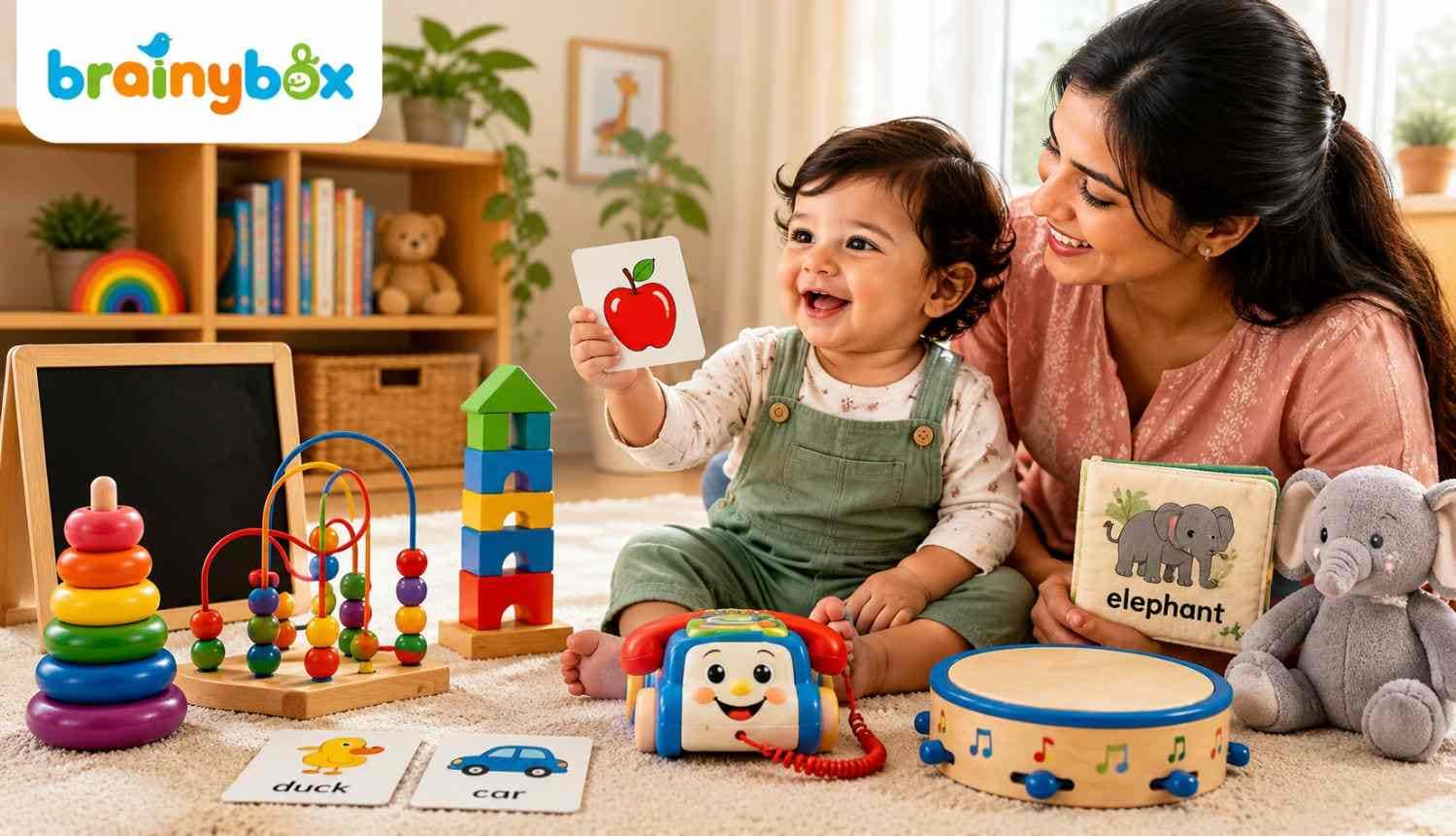
The best speech development toys toddler parents should buy include those that are simple, non-screen-based, and promote interactive communication, such as stacking cups, cloth books, matching cards, and pretend play sets. In essence, toys that aid in speech development perform better if they prompt your kid to talk, point, and react to you rather than just watch or listen.
This article details exactly which toys are effective in aiding the development of speech and language and how you can choose the appropriate toys based on age groups. If you are seeking toys for speech therapy for a 2-year-old child or toys for the development of language, you have come to the right place.
What Are Speech Development Toys?
Language development toys are toys selected and crafted with the purpose of encouraging the child to babble, imitate sounds, learn new words, and formation of sentences through playing. In contrast with toys that are made just for fun, language and speech toys have a lot to do with communication, regardless of whether it involves object naming, turn-taking, or storytelling.
These toys range from such simple items as rattles for babies to play kitchen sets for toddlers. What unites them all is one common purpose – providing a motivation for the child to communicate.
Why Speech and Language Toys Matter
Language acquisition occurs quickly during toddlerhood, and the appropriate play setting definitely facilitates the process. As outlined in the developmental milestones provided by CDC’s Learn the Signs. Act Early. campaign, the average toddler can say about 50 words and even combine them in two-word sentences by 30 months of age, though there is considerable individual variation.
There is no more natural way of developing language skills than through play. A child playing with a toy telephone and asked to “speak” into it, or pointing to a picture in a cloth book and hearing its name spoken back to them, is really learning how to communicate in a stress-free and fun manner.
How Toys That Help With Speech Development Actually Work
However, not all educational toys help with speech development. It becomes quite obvious from the research below.
According to speech-language pathologists, educational toys, which foster turn-taking interactions between a child and a parent, provide significantly more opportunities for language development than toys that just talk, sing, and light up.
As one of the certified speech-language pathologists said during research conducted by the Center for Audiology, Speech, Language, and Learning of Northwestern University, talking, noisy toys that sing songs themselves do not give parents many chances to interact with the child, while such interaction is the very basis of communication.
It is an effective criterion while choosing a toy. A toy that sings songs by itself can be interesting; however, a toy that involves a parent in singing, naming pictures, or taking turns is really helpful.
The Interaction Principle: A Quick Reference
Toy Type
Encourages Interaction?
Best Use
Cloth or board books
Yes, strongly
Naming pictures, pointing, repeating words together
Building blocks
Yes, strongly
Storytelling, pretend play, describing what is being built
Battery-powered talking toys
Limited
Occasional use, not a primary learning tool
Matching or sorting cards
Yes, strongly
Vocabulary building, categorizing, describing
Musical instruments
Yes, moderately
Turn-taking, rhythm, sound imitation
Types of Speech Therapy Toys and Language Toys
Knowing the key types of speech language toys will help in choosing toys for the first time or expanding a collection.
Cause-and-effect toys. Such toys give predictable reaction to a toddler's action, for example, a pressable button that causes the toy to make a sound; cause-and-effect toys are perfect for very young toddlers.
Sets for pretend play. Kitchen toys, doctors' sets, and teapots naturally lead to narrating as children explain what they are doing while playing.
Books and flashcards. Simple books and flashcards are still some of the most effective speech toys because naming objects is one of the most efficient methods of developing a vocabulary.
Games of matching and sorting. Toys that develop speech stimulate descriptions, comparing, and classification, thus helping with both developing a vocabulary and building sentences.
Musical and rhythmic toys. Simple instruments are helpful in developing turn taking and sound imitation.
Best Toys for Language Development by Age
Choosing the right toy really depends on where your toddler currently is developmentally. Here is a general breakdown to guide your shopping.
Language Development Toys for Infants (0 to 12 Months)
This is the time when your baby will be reacting to sounds, faces, and cause-and-effect actions but not words yet. This is why books with high contrast pictures, soft rattles, and basic musical toys would suit at this age, as babies are just developing skills that will be used later in language learning.
If you need age-specific recommendations, check our shop by age range 0 to 12 months category.
Speech Therapy Toys for 2 Year Olds
Most children at this age have started using words and are acquiring new words fast. Matching games, simple busy books, and dramatic play toys will do well in such cases, since children at this age have already acquired the ability to name and classify objects.
Both the matching card game and the marine numbers busy book are geared towards children in this age bracket.
Speech Therapy Toys for 3 Year Olds
By the age of three years, kids have already started learning how to form sentences and tell stories. Such toys provide opportunities for kids to construct complete sentences rather than just words through their pretend play with them.
If you are trying to find out what your toddler would really like, then you can visit our comprehensive review about top toys for a 1 year old, where we talk about changing toy requirements with toddler development.
Games That Stimulate Language Development
Beyond individual toys, certain games and activities to encourage speech and language development work especially well across almost any age.
Games and Activities Checklist
Hide-and-seek games like peekaboo, which create anticipation and teach words such as “again” or “more.”
Games in which you show an object and ask your child to say what it is called.
Sorting games, using different toys sorted according to color, shape, or function.
Songs involving movements that repeat, for example, clapping songs.
Storytelling with gaps, in which you pause in the middle of a sentence and let your child say the next word.
Our music toy is a simple, screen-free option that works especially well for turn-taking games like these.
Activities to Encourage Speech and Language Development at Home
However, toys prove effective when used in connection with certain regular activities, not when used separately.
Narrate the events of the day. Talk aloud about your actions while you are performing them, whether you are washing dishes, putting on clothes, or eating food, as your toddler will come across new words in this way naturally.
Expand on the phrases said by your toddler. If your child uses the word "car," say "yes, a red car" to give an example of a bit longer phrase.
Repeat the same stories. Since repetition assists toddlers in memorizing new words, you should not worry about constantly repeating the same story at bedtime.
Avoid screen use during play. According to the American Academy of Pediatrics, you should limit screen use for your toddler since playing and talking provide better opportunities for vocabulary growth.
Choose the subject according to your toddler's preferences. When you have noticed that your toddler is interested in something, use his/her interests as the starting point.
Best Toys for Speech Delayed Toddlers
When specifically seeking the ideal toys for a speech-delayed toddler, the same general guidelines hold true, but perhaps with even more focus on organization. Toys that provide predictable naming exercises will be most effective for speech-delayed children due to their repetitive nature and predictability.
Picture books, matching games, and imaginative play sets that reflect daily life activities, such as a toy kitchen, are some of the most effective options for speech-delayed toddlers. However, if you have worries about your toddler's speech development, toys should assist your efforts, not hinder them.
An evaluation from your child's pediatrician or a speech-language pathologist—one from the American Speech-Language-Hearing Association, for instance—is necessary if you believe there may be a problem.
Common Mistakes When Choosing Speech and Language Toys
Even well-intentioned toy shopping can miss the mark. These are the most common mistakes parents run into.
Mistake
Why It's a Problem
Better Approach
Choosing toys purely because they talk or sing
Limits opportunities for real caregiver interaction
Prioritize toys that invite you to play together
Buying toys too advanced for your child's stage
Can lead to frustration rather than engagement
Match toys to your toddler's current age and ability
Relying on screen-based apps for language learning
Reduces the face-to-face interaction children need most
Choose screen-free, hands-on toys instead
Only using a toy once and moving on
Misses the repetition children need to internalize new words
Reuse favorite toys regularly, since repetition builds language
Ignoring noise levels
Loud toys can be uncomfortable and offer little language benefit
Test toy volume yourself before offering it to your child
Toddler Educational Toys: Beyond Speech Alone
Although speech-related toys do have their own merit, these are better off being a part of a larger collection of educational toddler development toys. Educational toys that provide well-rounded developmental opportunities for toddlers promote the development of physical skills, problem-solving, and social skills, along with the development of language.
Educational toys for toddlers usually coincide well with the toys designed for developing language because most of them use language in one way or another during these activities, even though this may not be the main goal of the activity itself.
How BrainyBox Supports Speech Development
For all toys sold at BrainyBox, we select each one taking into account not only actual developmental milestones, but also the type of caregiver engagement that truly promotes speech-language development.
We create toys without screens, which are made to inspire the kind of playful interaction that is highly recommended by speech-language pathologists.
You are welcome to view our full online store to see what options we have for all ages or go to our store by age collection, where you will find toys tailored just for your child’s development stage. We use only natural, safe materials to make all our products.
Final Thoughts
Selecting the appropriate toys that help speech development does not need to be a difficult task. The best toys to choose are those that draw you into playing with them and offer plenty of opportunities for naming and talking.
Now that you know what kind of toys to look for, why not explore the collection of BrainyBox's educational toys without any screens?
FAQs About Speech Development Toys Toddler
Q1. Which toys increase a toddler’s verbal communication?
Ans: Those encouraging naming, pointing, and turn-taking, such as books with pictures, matching cards, and toy sets, are most likely to promote speech development. The important thing is to choose the right toys to play together rather than entertain a child alone.
Q2. When do I begin using speech development toys?
Ans: From infancy, teach listening and response to sounds. Once your baby starts combining words from 18 months to 30 months old, the toys that improve speech become especially helpful.
Q3. Are electronic talking toys detrimental to my child’s speech?
Ans: They aren’t harmful, but according to research studies, talking toys are less beneficial in comparison with interactive toys, as they reduce conversation time with caregivers. It is better to use them occasionally but not as the main instrument.
Q4. How can I recognize a speech delay in my toddler?
Ans: It may be time to have a chat with the pediatrician if the toddler does not meet the expected milestones for language for his or her age, for example, does not start forming words around the age of two to two and a half.
Q5. Are toys for speech development effective, and do I need professional help anyway?
Ans: The toys may play an important role in the practice of language every day; however, they are most effective when used together with professional assistance if a real speech delay is diagnosed. Consider the toys as supportive tools, not a substitute for the evaluation and therapy.
Q6. How do toys for speech and language differ from educational toys in general?
Ans: The toys for the development of speech and language are selected in order to encourage naming, conversations and taking turns, while educational toys in general might target the development of motor skills, problem-solving, and creativity.